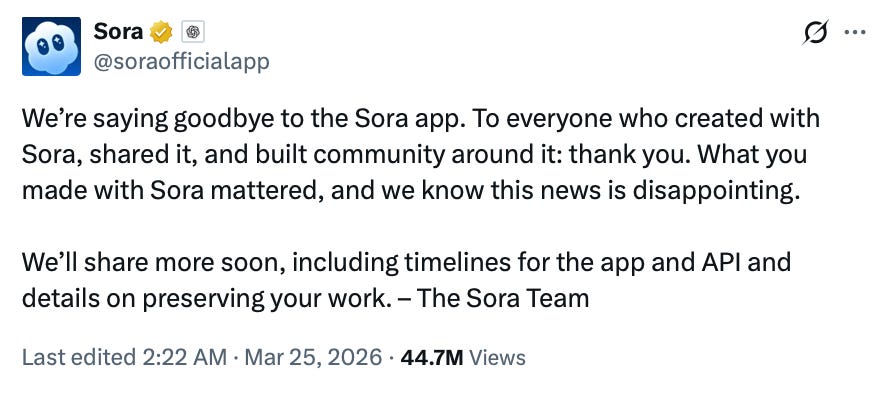
OpenAI shutting down Sora as a standalone product is useful not because it says anything profound about video generation, but because it reveals something much more important about consumer products: people do not want AI, creative superpowers, or infinite possibility nearly as much as the tech industry thinks they do.
They want less work.
They want momentum.
They want to get something done.
That is the mistake a lot of founders are still making.
They are mistaking a breakthrough in capability for a breakthrough in demand. Just because a model can generate cinematic video from text does not mean millions of consumers have a recurring desire for “cinematic video generation.” That is not a product insight. It is a technical milestone.
People do not want AI nearly as much as they want progress.
This sounds obvious in hindsight, but it is a lesson the market has to keep relearning every time a new technology wave arrives.
A model can now generate cinematic video, realistic scenes, stylized content, characters, or entire visual worlds from text. That is technically extraordinary. But the existence of a powerful capability does not automatically imply a large, durable user need around that capability. More often than not, it just creates a new class of demos.
And this is exactly why Jobs To Be Done (JTBD) still matters so much. It remains one of the few frameworks that consistently forces builders to ask the right question:
What job is the user actually hiring this product to do?
Because consumers do not buy capabilities.
They buy progress.
And if you miss that distinction, you can end up building something magical that nobody actually needs often enough.
The market rewards momentum, not novelty
Most consumers are not looking for tools.
They are looking for movement.
They do not wake up wanting “AI video generation.” They wake up wanting to make an ad faster, create a visual without hiring someone, send something funny to a friend, publish content without overthinking it, or avoid work that feels tedious, confusing, or creatively intimidating.
Those are jobs.
“Generate a realistic 12-second clip from a prompt” is not a job. It is a technical feature that may or may not attach itself to one.
That difference is where a huge number of consumer products go wrong, especially in moments like this when the underlying technology is moving so quickly that it is easy to mistake possibility for inevitability.
Sora created video
Founders naturally over-index on what is newly possible. Users do not. Users care about whether a product helps them make progress in a way that is meaningfully better than whatever they are doing today. Faster. Easier. Cheaper. Less cognitively expensive. More confidence-inducing. More socially useful.
That is what creates retention.
Without that, you might still get excitement. You might get screenshots, social sharing, a burst of curiosity, maybe even a strong launch. But you do not get habit. And in consumer, habit is what matters.
This is why so many AI products feel exciting in week one and irrelevant by week six. They are built around what the model can do, not around what the user is repeatedly trying to get done.
That is not a model problem.
It is a product problem.
JTBD remains the cleanest way to see what is real
A lot of product frameworks become less useful the more often they are repeated. JTBD has survived because it still explains actual user behavior better than most alternatives.
Users are not “using your product.”
They are hiring it.
And they are hiring it to make progress in one or more dimensions:
functional
emotional
social
That has always been true.
People did not hire Instagram to “share photos.” They hired it to project identity, taste, status, and belonging. People did not hire TikTok because they wanted “short-form video.” They hired it because it is one of the most efficient boredom-killing and attention-capturing products ever created. And people are not hiring ChatGPT because they want “AI.” They are hiring it because it removes friction from writing, thinking, planning, researching, summarizing, deciding, and getting started.
That is the actual wedge in consumer AI: not intelligence, but effort compression.
This is the point many AI-first products still miss. They are designed around what the model can output, rather than around what the user is trying to avoid.
But the best consumer products rarely ask users to admire the technology (TikTok is the OG when it comes to using AI to personalise your feed..but that tech part was only limited to people interested in tech, not the normal consumers)
The best AI products make the technology disappear into progress.
That is a much harder thing to build. It is also the thing that actually lasts.
People rarely know what they want. But they are constantly telling you what they hate.
This is where the Henry Ford quote, cliché as it is, still points to something important:
“If I had asked people what they wanted, they would have said faster horses.”
Consumers are usually poor at describing the solution.
They are much better at revealing the friction.
They will not tell you they want “an AI-native multimodal creative operating system.”
They will tell you (as is obvious from Reddit discussions):
“I need this ad by tonight.”
“I don’t know how to make this look good.”
“I hate starting from scratch.”
“Can this just do it for me?”
That is where product insight lives.
The best founders do not listen literally. They listen structurally.
They understand that users may not be able to imagine the right product, but they are constantly exposing the jobs they are trying to complete and the friction that is blocking them. That is usually where the real opportunities come from.
And it is also why so many “AI for creativity” products are at risk of overestimating the size of their market.
AI lowers the cost of creation. That does not mean everyone becomes a creator.
This is one of the most important questions in consumer AI right now, and I think the market is still underestimating how much it matters.
A huge number of AI-native consumer products are being built on an implicit assumption: if creation becomes dramatically easier, then a much larger percentage of people will become creators.
That sounds plausible.
It may also be wrong.
Historically, creation has always been much smaller than consumption (aka 1% rule, i.e. 1% create, 10% remix and 89% consume), even when tools become significantly easier to use. Most people do not want to create consistently. They want to consume, react, lightly remix, and occasionally produce something “good enough” with very little effort.
That was true before AI.
There is a very good chance it remains true after AI.
AI absolutely lowers the cost of making things.
But lowering the cost of making does not automatically increase the desire to make.
That distinction is subtle, but incredibly important.
Because if your product thesis depends on millions of users suddenly wanting to create on a regular basis, you may be building on top of a behavior that never actually changes.
Why products like Wabi may struggle
This is also why I am skeptical of products like Wabi (raised $20mn seed round, is a Silicon Valley darling) and the broader class of AI-native creative consumer apps.
That does not mean they cannot get traction. They can. In fact, many of them probably will. These products are highly legible to early adopters, creators, and tech-native users. They are expressive, socially shareable, and often fun in exactly the way that drives initial engagement.
But that is not the same thing as building a durable consumer business.
YouTube has “billions of monthly logged-in users”, over 20 million videos uploaded daily, and Shorts alone now averages 200B+ daily views
Because the underlying creator-versus-consumer dynamic may not actually shift very much with AI. If anything, AI may simply increase the supply of content dramatically while leaving the demand side structurally similar.
That is a dangerous asymmetry.
More supply does not automatically create more meaningful demand.
It often just creates more noise.
And what that likely leads to is not a creator revolution, but a more automated content economy:
a small number of highly leveraged creators
a wider layer of casual remixers
and a very large base of users who still mostly consume
If that is directionally right, then many AI-native creative apps will eventually run into the same wall:
Creation alone is not enough.
To become durable, they probably need to become one of two things:
1. A utility
Something that helps users complete a real, recurring job they already care about
2. A distribution layer
A place where people actually come to consume, not just create
The second is much harder than it sounds.
Because AI lowers creation cost.
It does not lower distribution cost.
And in consumer, distribution remains the bottleneck.
It still decides what wins.

The best AI consumer products will not feel like creativity tools. They will feel like relief.
This, to me, is the bigger lesson.
A lot of AI consumer products are still being built as if the opportunity is to give users more possibility. More outputs. More optionality. More expressive range. More things to generate.
But possibility is rarely the bottleneck. Completion is.
What most users are missing is not another blank canvas. It is fewer blocked moments.
They do not need more things they could make. They need fewer reasons not to finish.
That is why the strongest AI products will likely be the ones that remove:
hesitation
setup friction
execution anxiety
taste uncertainty
complexity
first-step paralysis
In other words, the winners will not be products that simply help users create more.
They will be products that help users move forward.
That is a much better product category.
And usually, a much better business.
tl;dr
Sora’s shutdown is not really about Sora.
It is a reminder of a much older truth that every technology cycle eventually rediscovers:
Consumers do not buy possibility. They buy progress.
They do not want AI for its own sake.
They want momentum.
They do not want infinite creative power.
They want to get something done with less friction.
And they definitely do not want another product that turns an impressive technical capability into one more thing they now have to learn, configure, and actively use.
That is why JTBD still matters.
Not because it is fashionable, but because it keeps pointing builders back to the only question that has ever really mattered in consumer:
What painful, recurring job can this product make easier, faster, or disappear entirely?
That is where the real companies get built.
Everything else is mostly a demo.
What consumer products are you building or consuming? Do share in the comments section